Pharmacovigilance · Medical Review
Quality medical review for pharmacovigilance teams.
Aegivance turns case processing into sponsor-defensible medical review.
We help sponsors, CROs, and generic pharma improve the quality, consistency, and defensibility of safety case review.
The Problem
CROs process the cases. Sponsors remain accountable.
Outsourced pharmacovigilance is the industry norm. The CRO codes the case, assesses seriousness, drafts the narrative, sends the ICSR. The sponsor signs.
But when a regulator asks how an event was assessed — or when the next product launch demands a different vendor — the sponsor has no shared, defensible record of how the medical review was actually done.
PV leaders, medical reviewers, and sponsors need consistent case quality they can defend.
The Solution
Aegivance is the medical review and quality evidence layer between CROs and pharma.
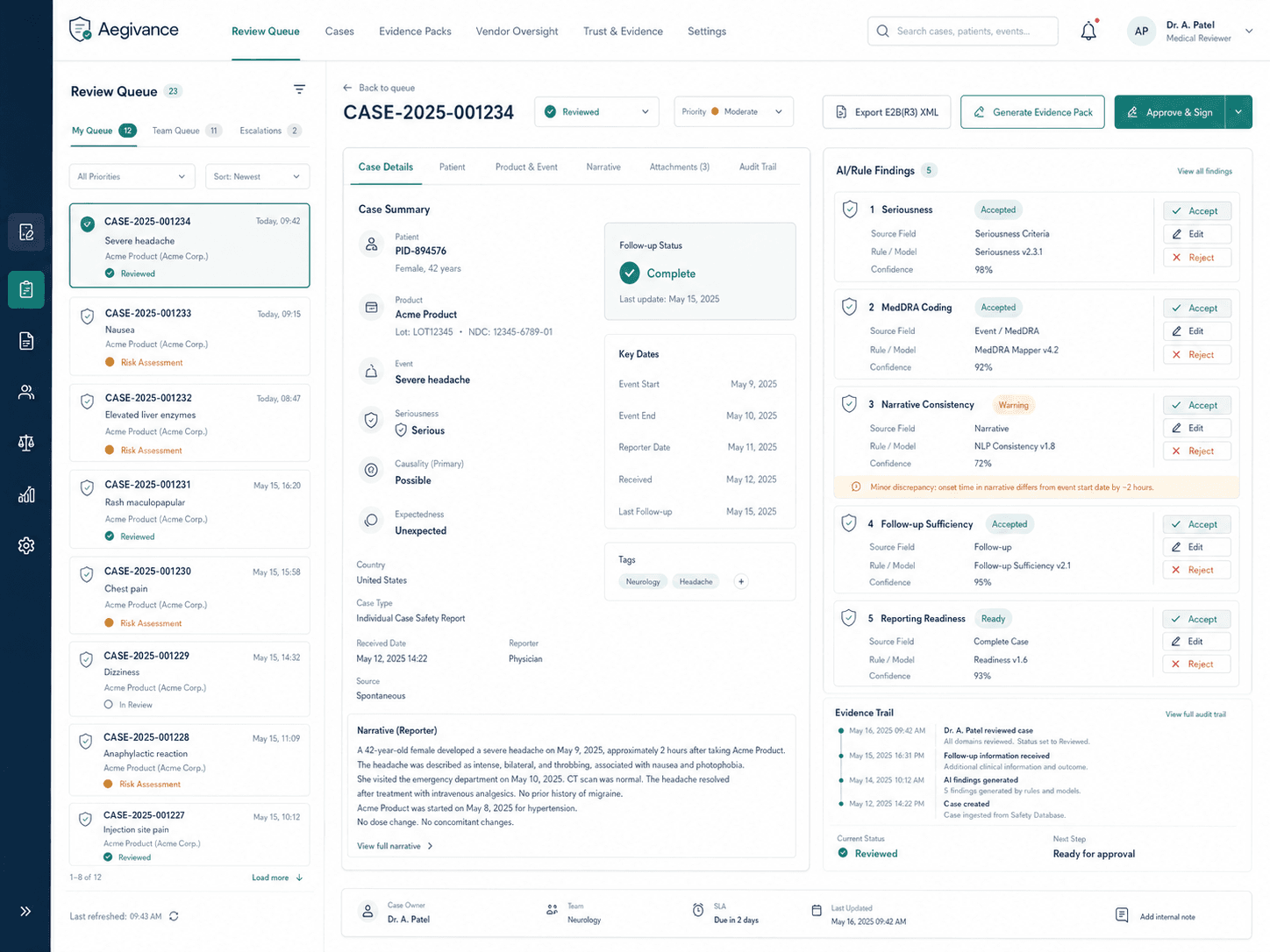
We sit between the CRO that processes the case and the sponsor who carries the regulatory weight. We review each case, surface medical-quality gaps, document the reasoning behind every reviewer decision, and turn the work into a shared quality record.
Review Quality
Layered review pipeline across the medical domains that matter — seriousness, causality, MedDRA, follow-up, narrative consistency, reporting readiness. Findings are typed, attributable, and link back to the source field.
Reviewer Evidence
Every reviewer decision is captured with its rationale, the rule or model that surfaced the finding, the version of each, and a timestamped record. Cases become reconstructable, not just signed.
CRO Oversight
Per-vendor scorecards. Defect rates by review domain. SLA aging. Repeat-error patterns. When you're choosing which CRO handles your next product launch, the answer is in the data.
Clinical Review Domains
Layered medical review across every case.
Each case runs through deterministic and evidence-assisted review checks. Rule-based checks are versioned; model-assisted outputs are logged with model and prompt versions on every finding.
Validity & completeness
The four-element ICSR completeness check, plus field accuracy, date logic, and cross-field consistency.
Seriousness
FDA 6-criteria assessment plus important medical events. Evidence-backed, reviewer-confirmed.
MedDRA coding
PT validity, version pinning per case, appropriateness review with rationale.
Follow-up sufficiency
Required labs, tests, and timing for case completeness. We flag what's missing before the regulator does.
Narrative consistency
Free-text checks against structured fields. Language clarity. Reviewer-readable summary.
Causality support
WHO-UMC evidence surfaced for the reviewer. The reviewer assesses. We document.
Reporting readiness
SUSAR criteria for FDA-applicable cases. Submission-flagged; never auto-submitted.
The Reviewer Layer
The reviewer decides.
Aegivance documents.
Model proposes. Validators enforce. Human approves.
No model signs a case. No automated regulatory submission. No deletion of records — corrections are appended.
Reviewers see findings with full provenance — the field, the rule or model, the version, the confidence, the prior reviewer's decision. They accept, reject, or edit. Every action becomes evidence.
Built For
For pharmacovigilance teams who carry the compliance risk.
Sponsors
You own the regulatory weight on every case.
Aegivance gives you objective, finding-by-finding evidence that the medical review was done correctly — and a shared record you can sit down with your CRO to walk through.
Learn moreCROs
Make case quality a sales asset.
Catch medical-quality gaps before the sponsor's QA team sees them. Create a documented case-quality record that becomes a competitive advantage, not a vulnerability.
Learn moreGeneric & Small Pharma
Inspection-grade quality without the headcount.
A scalable medical review layer for marketed-products portfolios. Independent review at a cost structure that matches your operation.
Learn moreThe Evidence Trail
Every finding, correction, reviewer decision, rationale, and export artifact — captured and reconstructable.
For the depth on cryptographic integrity, 21 CFR Part 11 mapping, IQ/OQ protocols, and our LLM governance policy:
See Trust & EvidenceValidator findings with rule version and model version
Reviewers can trace why a finding fired and reproduce the result.
Reviewer decisions with rationale and timestamp
The case file shows not just what was done, but why.
Field-level edits and corrections
Every change is appended. History is never destroyed.
Export artifacts — E2B(R3) XML, CSV, signed packs
Submission-ready outputs that match the underlying case state.
Per-tenant integrity record
Independent verification available on request.
The Pilot
A 3-month medical review quality pilot.
Run a sample of your historical safety cases through Aegivance. You'll receive a review-quality report covering findings by domain, reviewer acceptance rate, average review time, defect category breakdown, and evidence completeness against an audit-grade benchmark.
What we're transparent about
Three things we don't hide.
Model use is fully disclosed. Every model call is prompt-versioned and logged. PHI is scrubbed before any model receives a case. Models surface evidence; they never sign.
The product is in active development. Sponsor label / IB ingestion is on the roadmap. Argus profile UAT is pending first regulated customer engagement. We publish what's shipped and what's in flight.
Designed to support Part 11 controls. Our architecture is designed to support 21 CFR Part 11 signature-manifestation and audit-trail requirements. Customer validation under their own SOP is required for regulated use.
Ready to prove review quality across every case?
A medical review quality pilot, run against your historical cases. Bring a sample. Walk through the review domains. See the evidence trail end-to-end.
Request a Pilot